
Mississippi's Eighth Grade Reading Results
On March 16, 2026, The Hechinger Report published Jill Barshay's article, "Southern states boost early reading, but gains stall in middle school: why the ‘Mississippi miracle’ disappears by eighth grade." Todd Collins, one of the organizers of CA Reads, and a longtime student of Mississippi's reading initiatives, challenged that narrative in the letter below. He writes, "It's a shame to have a narrative that 'Mississippi doesn't work' when in fact, they are kicking butt."
Jill,
This is Todd Collins, I'm an education advocate here in sunny Palo Alto, CA. I focus mostly on "what works" and do a lot of NAEP analysis to find out. As a result, I've been an ardent student of MS's success (in reading AND in math) the last several years. Thank you for all your good reporting, which I enjoy.
I'm always glad to see reporting on Mississippi. But I think you got the story wrong in your report this week (sorry).
Three points: 1) you didn't include the incredible national headwind in 8th grade reading; 2) you didn't account for the long lag time to impact 8th graders; and 3) you didn't compare apples to apples by looking just at low-income kids (or some other demographic adjustment).
First - in fact, we have seen progress, especially in the most recent years. For low-income students, MS was THE ONLY STATE that posted improvement in 8th grade scale score between 2013 and 2024, a +3. And yes, +3 isn't much - but the average state was -10 points, a full year's worth of achievement lost.
Whatever you attribute this horrifying trend to (the Great Recession, smartphones, pandemic, take your pick), MS was THE ONLY STATE to buck the national tide. Against the stiffest headwind, they were the only state whose 8th grade scale score went up. And again, for low-income kids, their 8th grade ranking went from 50th in 2013 to 10th in 2024 - astounding progress.
I was surprised you didn't mention this incredible headwind effect - I think it is an under-reported story. We've on average lost a FULL GRADE of student achievement in 8th grade reading in the last decade or so. This is a profound effect.
.png)
Mississippi (red) bucking the national tide
Second - obviously improvement of 8th graders takes time. A key aspect of MS's approach was to focus hard on the early grades, especially with 3rd grade retention accountability. But Kinders in 2015 (the first year of implementation) didn't reach 8th grade until 2023, which means prior to 2024, no MS 8th grade had full exposure to the new policies (and in 2024, only the initial years). So we'd expect progress to lag by many years.
Third - Your graphs (I love graphs, btw, thanks for including) were "All Student" cohorts. "All Student"comparisons, as I'm sure you know, tell us more about demographic differences than state school policy or effectiveness. I look at only low-income kids in order to avoid conflating demographic mix effect with school impact. MS has the highest share of low-income kids in the country, so on average they will always be at a disadvantage to wealthier states.
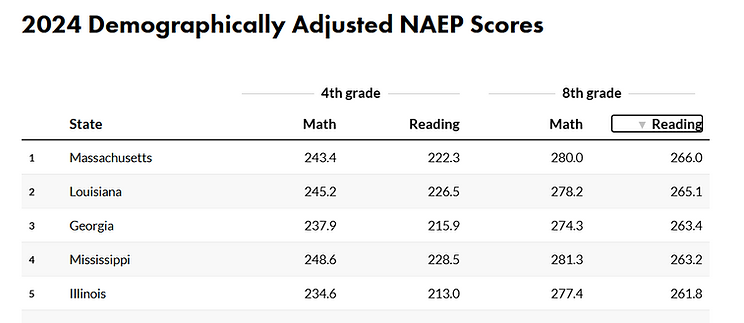
To compare fairly, you can either pick a cohort to compare ("apples to apples"), as I do, or you can re-weight scores to reflect demographics differences, like the Urban Institute. On the UI ranking, MS comes in #4 in the nation on 8th grade reading, along with Louisiana and Georgia in the Top 5. It's hard to square a narrative of MS failing in 8th grade with this kind of result.
.png)
Sorry to bury you with all this feedback - you can tell it's not the first time I've had to make this argument ;-) But I hope you'll reconsider and maybe do some additional reporting. It's a shame to have a narrative that "Mississippi doesn't work" when in fact, they (and other Southern states) are kicking butt.
Best,
Todd